
WHAT YOU NEED TO KNOW
What Causes Bulky Legs
While many people claim women can’t get “bulky” from lifting weights, some women are genetically predisposed to build muscle mass quickly. Three factors that cause your legs to feel bulky include:
-
Genetics: Having a “Strong Frame” (mesomorph) body type that is highly responsive to resistance training.
-
Skeletal Proportions: A shorter femur length makes muscle mass appear denser and more compact on the leg.
-
Muscle Memory: Past athletics, such as skating or soccer, can cause the lower body to regain muscle size rapidly.
If you gain muscle easily, following a standard heavy lifting program can lead to thicker thighs rather than the lean, toned look you’re aiming for. It’s important to understand your body type and how to train for it.
Why Do Your Legs Get Bulky So Easily?
You’ve probably heard it a hundred times:
“Women can’t get bulky from lifting weights.”
But that hasn’t been your experience.
If you feel like your lower body thickens from training…
If you gain muscle easily…
If you look at the squat rack and swear your quads grow…
I’m going to tell you something most people won’t:
Yes – some women absolutely can get bulky legs from weight training.
And if you feel gain muscle mass easily, I want you to trust your experience. In this article, I’ll help you understand why your legs feel bulky or thick – so you can stop feeling frustrated by advice that doesn’t fit your body type, and start focusing on what actually works for you.
Bulky Legs or Body Fat? Which Is It?
The standard message in the fitness industry has always been that women won’t get bulky legs – that they just need to lose fat. Right now, there are many high-profile female influencers encouraging women to train heavy, prioritise compound movements like squats, and reinforcing the message that women won’t get bulky from lifting weights.
And I need to address that directly.
There are several reasons someone might say women can’t get bulky from lifting weights.
- They may not have – or fully understand your body type.
- They may personally prefer a more muscular look.
- Their muscle may distribute differently.
- They may be focused on building strength, not shape.
- In many cases, they’re repeating widely accepted messaging without accounting for body type differences.
Let’s be clear – for some women it is a fat loss issue.
Women with our body type often feel better when we’re slightly leaner – especially in our legs. Even just a few pounds can make a difference.
But here’s the problem:
If you are already lean…
If you can see your abs reasonably well…
If you’ve dieted down and your legs still feel dense and muscular…
Then this is not simply a fat issue. I’ll use myself as an example.
I’ve recently taken off around 10lbs to lean out even more than usual. I’m pushing the point of where I can sit in terms of leanness without compromising my metabolism, hormonal health and strength.
And my legs? Still muscular and thicker than I would ideally like. So telling someone like me to “just lose fat” isn’t helpful – it misses the bigger picture.
Prefer to watch instead? I break this down in the video below.
Why Some Women Gain Muscle Easily (Body Type and Muscular Legs Explained)
Some of us build muscle – and bulky legs – easier than others. You may have heard of the term “mesomorph” which refers to the body type that tends to be more muscular and athletic looking. In my work, I call these ladies the “Strong Frames.”
Our body type is highly responsive to resistance training – meaning we gain muscle in our legs more easily than other body types.
I understand this body type well. I’ve lived in it my whole life. And there are some real positives to this body type but it also means we have to be very thoughtful and strategic with our training to avoid becoming bulky and thick in certain areas.
If we follow standard training programs with heavy squats, lunges, deadlifts and other compound movements, there’s a high chance we’ll just feel thicker. I’ve been there. When I first started training in my 30s, I had a fantastic coach but he didn’t understand the nuances of building a feminine shape and I ended up much more “bulky” that I wanted.
That’s the very reason I created Female Fitness Systems. At that time, there was hardly anyone talking about building a feminine shape and being more strategic with training. I had to teach myself through trial and error, and then I refined my approach through coaching women for over 10 years.
If you’re feeling confused about why your legs respond the way they do – and frustrated that generic programs don’t seem to work for you – the next step is understanding your body type properly.
You can take my free Body Type Quiz here.
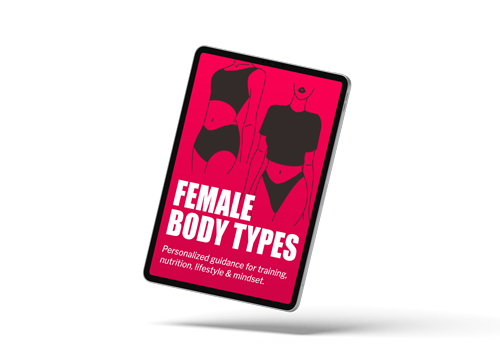
This isn’t one of those quick “you’re a square” responses. After completing it, you’ll receive a comprehensive ebook outlining how each body type responds to training, nutrition, and recovery including how to build shape strategically without creating unwanted bulk.
What Causes Bulky Legs In Women
Body type explains why you build muscle easily. Now let’s look at what specifically contributes to bulky-looking legs.
1. Genetics and Glute-To-Leg Ratio
Genetics influence how much you can develop your glutes and your legs.
One common misconception is that weight loss and/or training will lead to a dramatic change in shape, and that’s unfortunately not true. Shape is heavily influenced by genetics and muscle distribution. Many of the women you see on social media with “perfect” legs are benefiting from favourable genetics. If you’re reading this, you may simply be built differently.
And that’s the part most of the online conversation completely ignores.
You can train heavy squats and deadlifts for years – but if your thighs, quads and hamstrings grow more easily than your glutes, that may simply be how you’re built.
I’ve had to accept this myself. My glutes are strong and muscular, but they will never be dramatically round or dominant compared to my legs.
And if your glutes don’t project as much to create separation from your legs, your thighs and legs can appear thicker.
Unfortunately, no amount of glute-focused work will change that once you reach your genetic potential for glute development.

2. Femur Length, Height and Lower-Body Proportions

This factor is rarely discussed but it significantly affects how muscular your legs appear. Your bone structure determines how muscle is visually distributed.
Muscle spread over a longer femur looks leaner and more elongated.
The same amount of muscle on a shorter femur appears denser and thicker.
And:
A taller woman distributes muscle over more vertical length.
A shorter woman distributes that same muscle mass over less space.
The result?
Two women can have the same body composition – but one looks long and lean, while the other looks compact and muscular.
Self-Assessment: What Your Squat Can Tell You
Your squat mechanics can give clues about femur length.
If you can squat deep while staying upright, you likely have shorter femurs relative to your torso.
If you naturally lean forward significantly during squats, you likely have longer femurs.

3. Muscle Memory: Why Your Legs Gain Muscle Easily
Muscle memory is your body’s ability to rebuild muscle more quickly after it has already developed it once.
If you were athletic in your teens or twenties, your lower body may be highly responsive to training – even many years later.
Researchers are still studying the exact mechanisms behind muscle memory, but it could explain, at least in part, why you build and retain muscle easily.
In the context of muscular legs, this often shows up in women who played lower-body dominant sports such as:
- Skating
- Cycling
- Soccer
- Basketball
- CrossFit
- Sprinting
These sports involve thousands of powerful, repetitive lower-body contractions. Over time, they build dense, strong thighs that are very efficient at regaining size.
I experienced this firsthand.
I grew up on the ice, repeating explosive leg movements for hours a day. As a teenager, I felt embarrassed that my thighs were thicker than my friends. I assumed it was fat. At one point, I even bought a ThighMaster and started training my inner thighs directly – not realizing I was simply stimulating already overly muscular legs to grow even more.
Looking back, my legs weren’t fat at all – they were more muscular than average from years of skating.
Even after long breaks from training, those muscles can respond quickly when you resume strength work – making your legs feel like they grow faster than the rest of your body.
The Mindset For Women With Muscular Legs
After coaching women who gain muscle easily for over a decade, I’ve noticed something consistent:
They often have incredible legs – just not the kind that goes viral on social media.
They have strong, athletic legs that will support them as they age.
They often have less cellulite than other body types.
They tend to hold muscle well and maintain strength over time.
But they don’t see what I see. Instead, they focus on what they can’t change – their structure, their proportions, their natural muscle distribution.
As you get older, the balance between strength and appearance becomes more nuanced. Those same muscles that feel “too thick” in your 20s can actually smooth the appearance of skin and support joint health in your 40s, 50s, and beyond. Many women eventually shift their focus from “How small do my legs look?” to “How strong will they keep me?”
But caring about strength doesn’t magically erase aesthetic preferences.
I’ve felt this tension myself.
Over the past couple of years, I experimented with lifting heavier for my legs to maintain strength – nowhere near powerlifting territory, but heavier than I had in the past. And my legs responded quickly. They became noticeably thicker.
Recently, I’ve returned to lower volume, minimal quad-dominant loading, mostly bodyweight work for squats and lunges, and heavier loading only for direct glute work. This strikes the right balance for me between maintaining strength and aesthetics.
How To Get Leaner Legs Without The Bulk – What’s Actually Possible?
Here’s the honest answer:
You may not be able to dramatically change the overall structure or proportions of your legs. But you can influence how you train and reduce the likelihood of getting too bulky or thick.
If your goal is leaner looking legs, you can:
- Reduce heavy quad-dominant movements
- Prioritise glute-focused exercises
- Decrease overall lower-body training volume
- Scale back activities that heavily stimulate your legs
- Stay within a healthy, sustainable body fat range
I get it. It’s frustrating to train hard, eat well, be leaner than average – and still not be able to change your legs as much as you want.
Just remember, for women like us, more is not always better. The first and best step is understanding your body type so you know what to focus on.
If you want to go deeper:
- Take my Body Type Quiz (you’ll receive a detailed ebook explaining each type and how to train for yours).
- Watch my video on building leaner-looking legs.
- Explore my online training programs – they’re the exact workouts I follow myself.
Inside my app, you can upload photos and receive personal feedback from me. Sometimes the biggest relief comes from working with someone who understands your goals and your structure.
And remember:
Don’t let anyone dismiss your experience.
Some women don’t gain visible muscle easily from lifting.
Some absolutely do.
The key is knowing which one you are and training accordingly.